
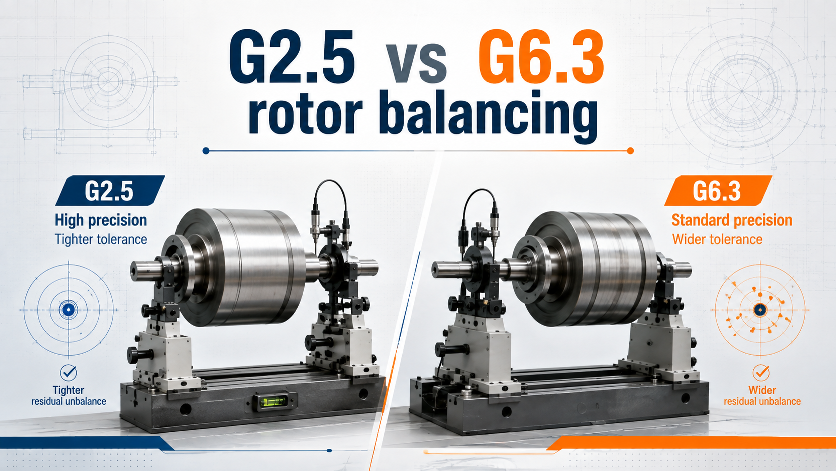
G2.5 is a tighter balance quality grade than G6.3, but the difference is often misunderstood. It does not mean a rotor balanced to G2.5 will have “2.5 grams” of unbalance. The grade is used with speed to determine permissible specific residual unbalance.
How much tighter is G2.5?
At the same rotor mass and reference speed, the permissible residual unbalance for G2.5 is approximately 2.52 times lower than for G6.3 because 6.3 / 2.5 = 2.52.
| Example: 100 kg at 1500 r/min | G6.3 | G2.5 |
|---|---|---|
| Permissible specific residual unbalance | ≈ 40.1 µm | ≈ 15.9 µm |
| Total permissible residual unbalance | ≈ 4010 g·mm | ≈ 1590 g·mm |
The correction mass that corresponds to those values depends on correction radius. For example, 1590 g·mm could be represented by 6.36 g at a 250 mm radius if it were concentrated in one plane. A two-plane rotor requires proper allocation between planes.
When G6.3 may be appropriate
G6.3 is widely used as a general industrial balance grade for many fans, pumps, process rotors and machinery components. It can be entirely adequate where the machine design, bearing system and operating speed do not require a tighter rotor balance.
When G2.5 may be justified
G2.5 can be appropriate for higher-speed or more vibration-sensitive equipment, precision rotating assemblies, or where the OEM explicitly specifies it. A tighter grade can reduce the unbalance force attributable to the rotor, but only if the rotor can be mounted and corrected repeatably to that level.
Why “tighter is better” can be wrong
Suppose a pulley is balanced to a very small residual unbalance on a mandrel, but the bore-to-shaft clearance allows the pulley centre to shift by more than the permitted eccentricity. The assembly may no longer meet the same balance state after installation. The same issue can arise from keyways, tapered fits, detachable hubs, corrosion, dirt or inconsistent seating.
A tighter grade also increases balancing time and the sensitivity to small changes in correction mass. That may add cost without improving the installed machine if other vibration sources dominate.
Installed vibration is a different acceptance question
Rotor residual unbalance and installed machine vibration are related but not identical. A rotor can meet G2.5 and still vibrate because of resonance, alignment, looseness, bearings, hydraulic or aerodynamic forces, eccentric assembly or structural problems. Conversely, a machine may run acceptably with a rotor that does not need an unnecessarily tight grade.
Decision rule
- Use the OEM or contractual requirement first.
- Use operating speed, not balancing-machine speed alone, when the grade calculation requires the service reference speed.
- Confirm the rotor can be mounted repeatably enough to make the tolerance meaningful.
- Specify the assembly condition and key convention.
- Do not use G2.5 as a marketing label when G6.3 is the correct engineering requirement.
For the underlying calculation, see What ISO 21940 balancing grade should I specify?