
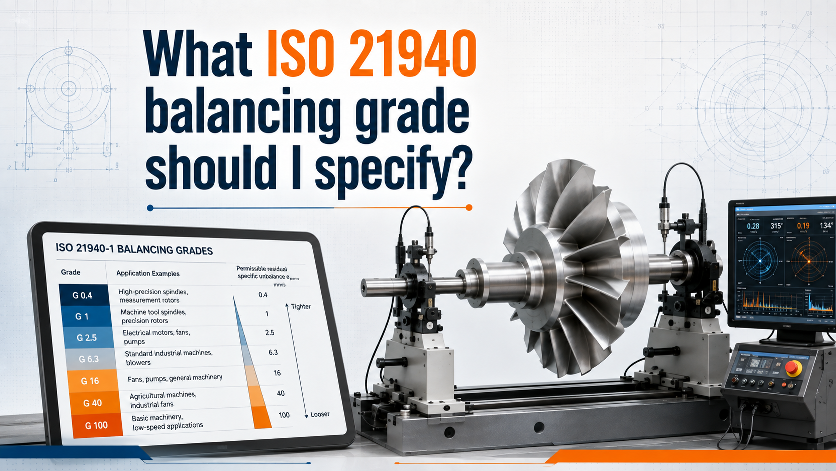
A balance grade is not a universal “good” or “bad” number. The correct requirement depends on the rotor type, service speed, machine sensitivity, OEM requirement and the condition in which the rotor is balanced and assembled.
Start with the current standard
For rotors with rigid behaviour, the current ISO reference is ISO 21940-11:2016, together with its 2022 amendment. The older ISO 1940-1 standard has been withdrawn and replaced by ISO 21940-11. If a drawing still says “ISO 1940 G6.3”, the intent is usually recognisable, but new specifications should reference the current standard.
What the G number means
The balance quality grade G has units of velocity. For a rigid rotor, the allowable specific residual unbalance decreases as speed increases. A useful engineering relationship is:
eper = G / ω
where eper is permissible specific residual unbalance and ω is angular speed. In convenient workshop units:
eper (µm) ≈ 9549 × G / n, where n is speed in r/min.
Total permissible residual unbalance can then be related to rotor mass. Numerically, U (g·mm) = e (µm) × rotor mass (kg). Allocation to individual correction or tolerance planes is a separate step and should not be reduced to “divide by two” without considering rotor geometry and the specified procedure.
Example: 100 kg rotor at 1500 r/min
| Grade | Specific residual unbalance | Total residual unbalance |
|---|---|---|
| G6.3 | about 40.1 µm | about 4010 g·mm |
| G2.5 | about 15.9 µm | about 1590 g·mm |
This shows why the same grade becomes more demanding at higher speed and why a grade cannot be interpreted without speed and mass.
Which grade should you choose?
Use the machine or rotor manufacturer’s requirement first. If the OEM drawing, purchase specification or applicable product standard gives a balance tolerance, that should normally take precedence over a generic grade selected later.
Where no specific requirement exists, a grade can be selected from the type of machinery and expected duty. General industrial fans, pumps and machinery are often associated with grades in the G6.3 region, while more demanding high-speed or precision rotors may require G2.5 or tighter. That is a starting point, not a substitute for engineering judgement.
Do not specify a tighter grade automatically
A very tight grade can be meaningless if the rotor cannot be mounted repeatably to that level. Bore clearance, key convention, shaft runout, detachable fitments, mandrel repeatability, contamination, correction resolution and measurement uncertainty can all become larger than the stated tolerance. In that case the specification looks impressive but does not represent a repeatable manufacturing condition.
What to put on a purchase order or drawing
- Applicable standard, for example ISO 21940-11
- Balance quality grade or explicit residual-unbalance tolerance
- Reference speed used to calculate the tolerance
- Rotor mass and the assembly condition to be balanced
- Required correction planes and any prohibited correction zones
- Key convention, where keyed components are involved
- Any OEM-specific verification or reporting requirement
Practical recommendation
If you do not know which grade to state, provide the rotor type, mass, operating speed and machine duty first. It is better to agree a technically defensible acceptance basis than to select G2.5 simply because it sounds more precise.
Related service: industrial dynamic balancing in Malaysia.