
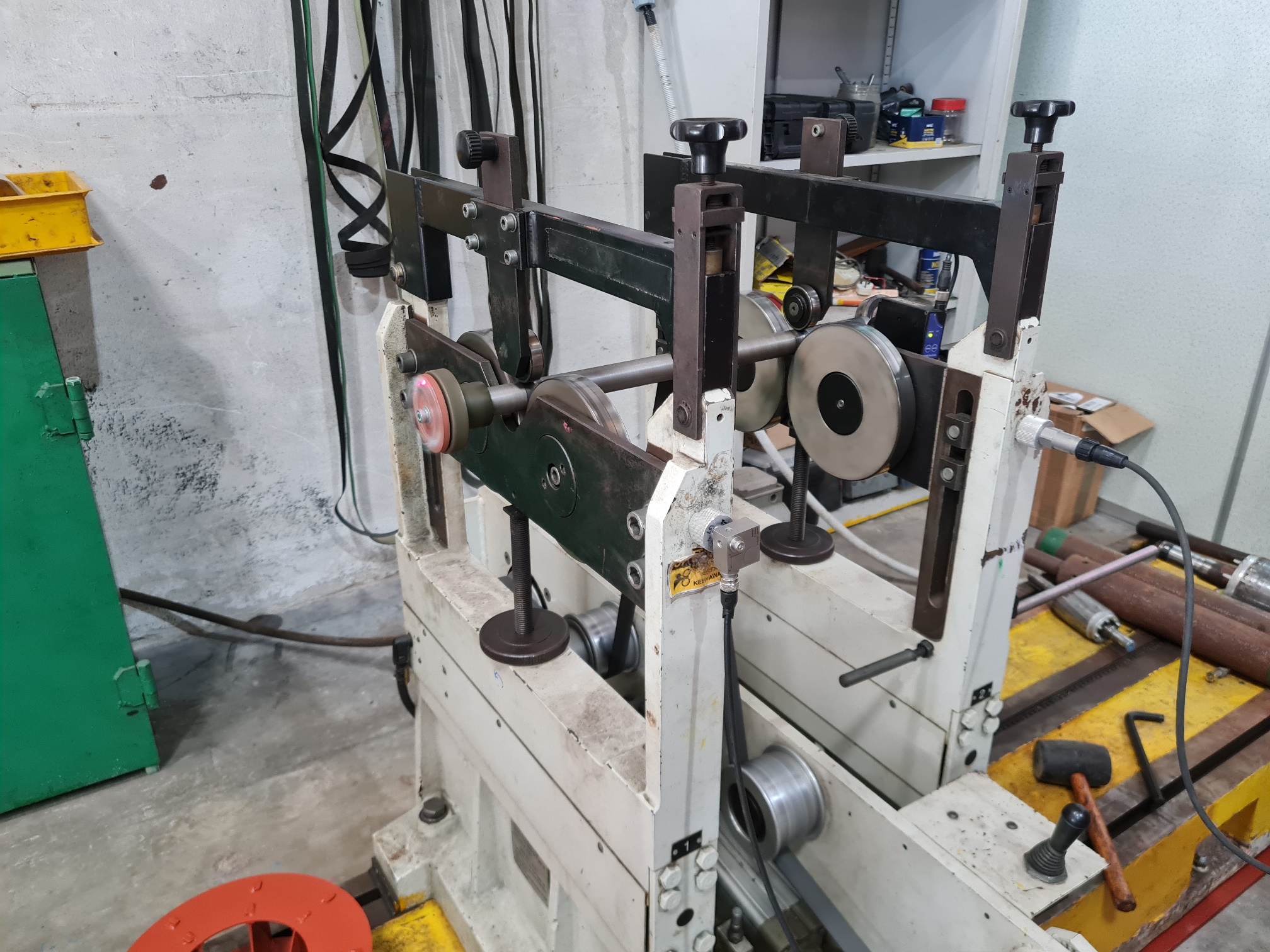
Dynamic balancing is used to reduce mass eccentricity in a rotating component so that the residual unbalance is within an agreed tolerance. RDB provides workshop balancing in Subang Jaya for industrial rotors that can be safely mounted and driven within the declared machine envelope.
Rotors typically considered
- Industrial fan rotors and blower wheels
- Pump, process and blower impellers
- Drums, rollers and cylindrical rotors
- Shafts, shaft-and-pulley assemblies and similar rigid rotors
- Other industrial rotating assemblies where suitable journals or tooling are available
Acceptance is based on the actual rotor, not the category name. A rotor may be rejected or require additional preparation if its journals, condition, geometry, centre of gravity, stored energy, contamination or correction access make the setup unsafe or the measurement unreliable.
Common reasons a rotor is sent for balancing
Typical triggers include elevated once-per-revolution vibration, a rotor that has been repaired or rebuilt, blade or material loss, replacement of rotating parts, weld repair, machining, or a requirement to verify residual unbalance before assembly. These symptoms do not prove that unbalance is the only fault; they are reasons to assess the rotor.
Current rotor size capability
| Parameter | Declared machine envelope |
|---|---|
| Rotor mass | Below 800 kg |
| Maximum diameter | 1.3 m |
| Rotor length | 400 mm to 2.5 m |
Final acceptance depends on the complete geometry, journals, centre of gravity, drive arrangement, guarding and safe correction method—not only the headline dimensions.
Single-plane and two-plane balancing
A narrow, disc-like rotor may sometimes be corrected in one plane when couple unbalance is insignificant for the operating condition. Longer rotors, or rotors where unbalance is distributed axially, normally require two correction planes so that both static and couple components can be controlled. The required method is determined from rotor geometry, operating duty and the measured response rather than from a single diameter-to-length rule.
Correction methods
Depending on the component design and customer authorisation, correction may be made by controlled material removal, approved addition of balance mass, relocation of existing weights or another documented method suitable for the rotor. RDB will not intentionally weaken a safety-critical feature or make an unapproved structural modification simply to reach a number.
What the customer should provide
- Rotor description and machine duty
- Approximate mass and main dimensions
- Journal diameters, usable journal lengths or mounting details
- Normal operating speed and, where relevant, maximum service speed
- OEM balance requirement or specified ISO grade, if available
- Photographs from both ends and the side
- Details of recent repair, machining, blade replacement or previous balance work
- Known contamination, chemicals, residues or trapped pressure information before delivery
Balancing report
The job record can document rotor identification, setup information, measurement results, correction information and final verification. Where an acceptance tolerance has been agreed, the final result should be read against that stated basis rather than as a generic “pass” that applies to every possible machine installation.
Subang Jaya workshop
RDB’s balancing workshop is at Jalan Subang 4, 47500 Subang Jaya, Selangor. Customers can send preliminary dimensions and photographs before arranging transport so that obvious setup limitations can be identified early.