
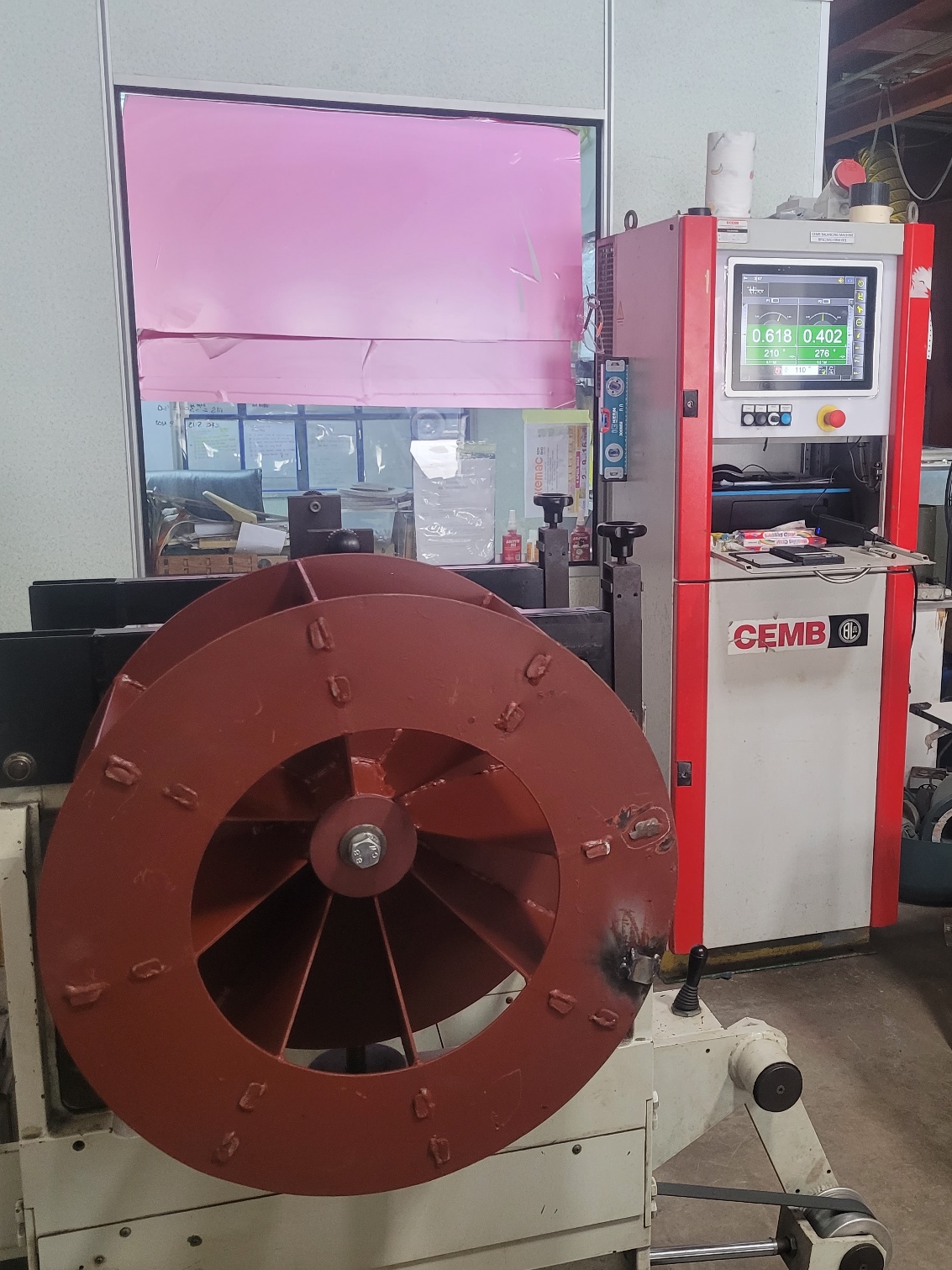
Industrial fan rotors can accumulate or lose mass through erosion, deposits, corrosion, blade repair, weld build-up and component replacement. Dynamic balancing reduces the unbalance that remains in the rotor, but it should be carried out only after the rotor is mechanically sound and the intended assembly condition is defined.
Typical fan types
- Centrifugal fan rotors and blower wheels
- Backward-curved and forward-curved fan wheels
- Radial-blade industrial fans
- Axial fan rotors where suitable mounting and correction planes are available
- Fan shaft-and-wheel assemblies
Common imbalance symptoms
Possible indications include elevated vibration dominated by running speed (1× RPM), repeated bearing vibration after a rotor repair, vibration that changes after cleaning or deposit loss, or a fan that becomes rough after blade or hub work. These are not unique signatures of unbalance. Installation faults, resonance, bearing condition, looseness, alignment and aerodynamic excitation must still be considered if the machine remains troublesome after the rotor is verified.
Rotor size capability
| Parameter | Current declared capability |
|---|---|
| Rotor weight | Below 800 kg |
| Maximum rotor diameter | 1.3 m |
| Rotor length | 400 mm to 2.5 m |
Fan width, overhung geometry, journal spacing, centre of gravity and guarding can be as important as overall diameter. Send dimensions and photographs before transport.
Single-plane vs two-plane balancing
A narrow fan wheel may sometimes behave sufficiently like a disc for one-plane correction. A wider rotor, a rotor with two separated side plates, or a shaft-and-wheel assembly can contain significant couple unbalance and normally requires two-plane correction. RDB selects the measurement and correction approach from the actual geometry and response rather than assuming that every fan can be corrected in one plane.
Correction methods
Possible correction methods include material removal at approved locations, addition of balance weights, or relocation of existing weights. The method depends on the fan construction, blade and side-plate design, previous repairs, operating environment and customer approval. Welded correction is not automatically appropriate for every rotor.
What the customer should provide
- Fan type and machine application
- Rotor weight, diameter, width and overall shaft length
- Journal diameters and usable journal lengths
- Operating speed
- Whether pulley, coupling, key and other rotating fitments remain installed in service
- Photographs of both sides, hub, journals and any previous repair
- Known vibration readings, if available
- OEM or contractual balance requirement, if specified
Balancing report
The balancing job record can include rotor identification, setup, initial readings, correction information and final residual-unbalance verification. If a specific acceptance grade or OEM tolerance is required, it should be stated before the work is closed.
Subang Jaya workshop
RDB carries out workshop fan rotor balancing at Jalan Subang 4, 47500 Subang Jaya, Selangor. A preliminary photo-and-dimension review is recommended for large, unusual or repaired fan rotors.
For broader background, see Fan impeller balancing problems and Why a balanced rotor can still vibrate after installation.