
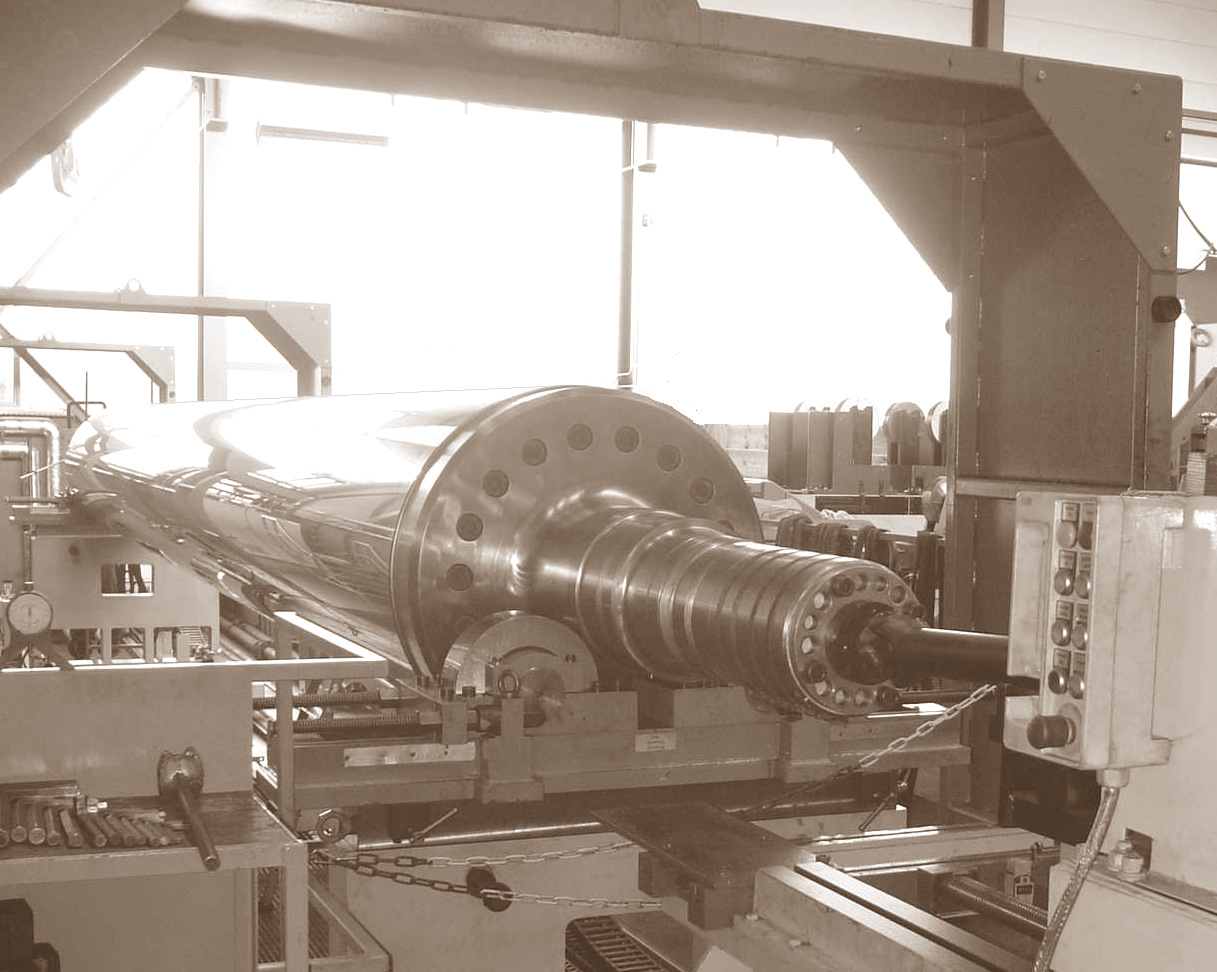
Drums and rollers often look geometrically simple, but their balance quality depends heavily on shell straightness, end-plate concentricity, journal runout, weld distortion and whether the internal condition is stable. Balancing should follow mechanical inspection rather than be used to compensate for a visibly bent or unstable rotor.
Typical drum and roller types
- Conveyor and process rollers
- Drive and idler drums with integral shafts
- Fabricated cylindrical rotors
- Roller-and-shaft assemblies after repair or re-machining
- Other rigid cylindrical components with suitable journals
Common imbalance symptoms
Running-speed vibration, repeated bearing loading, vibration after shell repair, a change following weld build-up or machining, and poor behaviour after journal replacement can justify a balance check. If runout, misalignment or structural resonance is dominant, balancing alone will not remove the installed vibration.
Rotor size capability
| Parameter | Current declared capability |
|---|---|
| Rotor weight | Below 800 kg |
| Maximum diameter | 1.3 m |
| Rotor length | 400 mm to 2.5 m |
Long slender rollers may have flexible behaviour at some speeds. Where the rotor does not remain effectively rigid in the balancing condition, a normal rigid-rotor balance procedure may not be sufficient.
Single-plane vs two-plane balancing
Most industrial drums and rollers have meaningful axial length, so two-plane balancing is commonly required to control both static and couple unbalance. A one-plane result can leave a couple component that is not visible as a simple heavy spot when the rotor is stationary.
Correction methods
Depending on construction, correction can be made by approved material removal, addition of balance mass to end plates or designated locations, or modification of existing weights. The shell, pressure boundary, wear surface and structural welds must not be compromised by an unsuitable correction method.
What the customer should provide
- Roller or drum application
- Mass, shell diameter and face/overall length
- Journal diameters, usable support lengths and bearing locations
- Operating speed
- Known runout measurements, if available
- Details of re-tubing, weld repair, journal replacement or machining
- Any internal liquid, loose material or process residue condition
Balancing report
The report can identify correction planes, initial measurements, applied corrections and final verification. For repaired rollers, it is useful to keep runout or geometry inspection records separate from the balance result so the two conditions are not confused.
Subang Jaya workshop
RDB performs drum and roller balancing in Subang Jaya. For long rotors, send journal-to-journal distance, overall length and centre-of-gravity information if available so the setup can be assessed before transport.