
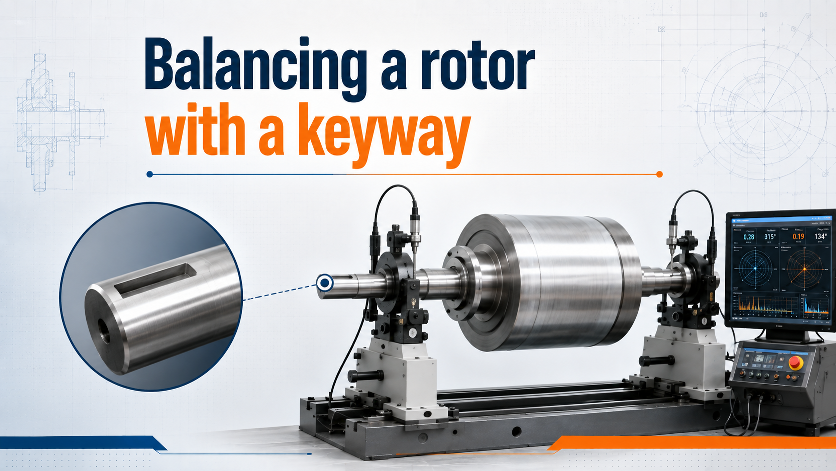
A keyway removes material from a shaft or hub, while the service key adds material back into the assembly. If the balancing condition does not represent the intended assembly convention, the key itself can become an artificial source of unbalance.
The core problem
Consider a shaft with a keyway and a pulley with a matching keyway. If the shaft is balanced with no key, it is balanced with the keyway material missing. If the pulley is also balanced independently under an incompatible convention, assembling both parts with a full key can produce a systematic error.
ISO 21940-32 half-key convention
ISO 21940-32:2012 specifies a half-key convention for balancing individual components of a keyed rotor assembly. The purpose is compatibility: separately balanced shafts and fitments should combine without the key convention itself creating excessive assembly unbalance.
The standard also covers the identification or marking of components balanced to the stated convention. For unusual key forms, the same principle is applied appropriately to the actual key geometry.
What “half key” means in practice
The exact implementation depends on whether the component being balanced is the shaft or the fitment and on the key geometry. It should not be improvised as simply “cut any key in half” without understanding the convention. For production or contractual work, use the standard and the OEM drawing or procedure.
Why a full key can give the wrong answer
If a shaft is balanced with a full service key but the mating component is separately balanced as though its keyway will also contain compensating mass, the assembled rotor can be over-compensated. The same problem occurs in reverse when both parts are balanced with empty keyways and then a full key is installed.
What if the whole assembly is balanced together?
If the final shaft, key and fitment are assembled in the exact service configuration and balanced as one permanent rotor, the actual assembled condition can be used. The important point is repeatability: if the fitment will later be removed, rotated or replaced, the resulting assembly may not reproduce the same balance state.
Key position also matters
When components are removed and reinstalled, the angular relationship between keyway, fitment and correction weights should be controlled. For a tight tolerance, an unmarked reassembly orientation can introduce variation even if each component was originally balanced well.
What to record on the balance report
- Whether the rotor was balanced as a complete assembly or as separate keyed components
- The key convention used
- Key position or angular reference where relevant
- Whether pulley, coupling, hub or impeller remained fitted
- Any mandrel or tooling arrangement used
Common workshop mistake
Do not compensate for an unexplained 180° change simply by adding weight until the reading is low. If remounting or changing key orientation moves the unbalance vector substantially, first investigate fit, key convention and mounting repeatability.
Related service: industrial shaft balancing.